

Do You Tell A Fireman Thank You For Your Service
Almost half of U.S. veterans and agile service members feel uncomfortable with being thanked for their service, a new survey has revealed.
According to a poll commissioned by the Cohen Veterans Network (CVN), a national non-for-profit network of mental health clinics for post-9/11 veterans and military families, 49 percent of agile and former members of the armed services experience uneasy with the expression "Thanks for your service."
Information technology comes every bit 91 percentage of Americans used the expression, according to the survey, and as the country prepares to commemorate its former military service members on Monday for Veterans Day.
"I feel very uncomfortable when civilians say thanks for your service, because I don't know what to say back," said a veteran employed at a Cohen Clinic in Washington.
The poll found that instead of saying the simple thanks, virtually veterans and service members preferred gratitude that went beyond simple platitudes and that tried to connect with them on a more personal level.
Commenting on the survey, Dave Gowel, CEO of RallyPoint Networks, a digital platform for the military machine community, said: "What we've learned is if yous've met one veteran, you've met one veteran. Nosotros are every bit diverse in our interests as are civilians. When it comes to being thanked for our service, this multifariousness however applies and you lot tin can't brand anybody happy.
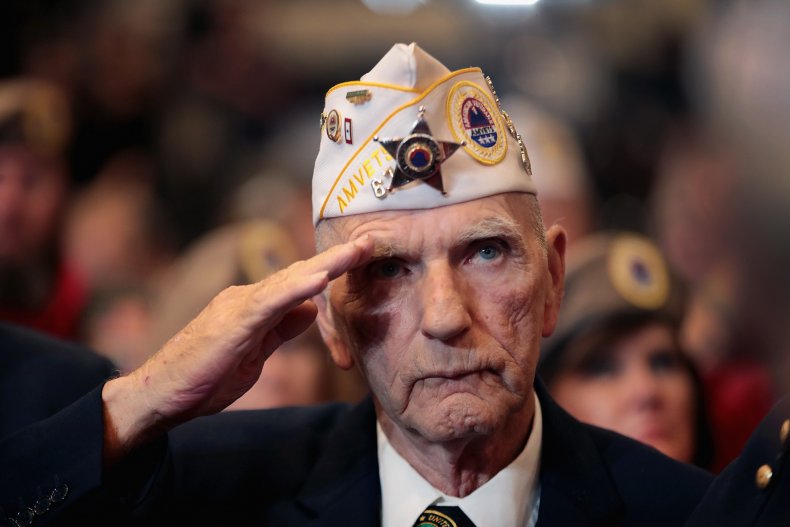
"We challenge you to evidence appreciation in additional ways for those who have repeatedly stepped in harm'south way on your behalf; remember most why you are saying thanks and realize you need to do more than bank check the block with a unproblematic phrase."
The survey revealed that veterans preferred questions about when they served, where were they stationed and what specific jobs they did while serving.
Its results were released alongside a new initiative launched by CVN titled "Beyond Thanks for Your Service," an sensation entrada aimed at connecting veterans and civilians in more meaningful ways.
"Taking an interest in a veteran'southward story virtually their time in the military machine is 1 way to engage beyond merely saying thank you for your service," CVN CEO and president Dr. Anthony Hassan said.
Some one-time service members said it would be more meaningful if people did more than for the veteran customs as opposed to only saying thanks.
"Instead of hearing 'thank you for your service,' I would similar to see civilians in our community give dorsum to military families," a veteran from Tennessee said. "Either by coaching a sport, giving a class, or going to a veterans home and simply sitting and listening to the stories of our older generations."
According to CVN: "The CVN Veterans Day Survey 2019 was conducted online within the United States past The Harris Poll on behalf of Cohen Veterans Network from October 10-14, 2019 among 2,019 U.S. adults ages eighteen and older, among whom 218 are U.S. military veterans or active-duty service members. This online survey is not based on a probability sample and therefore no estimate of theoretical sampling error can exist calculated."
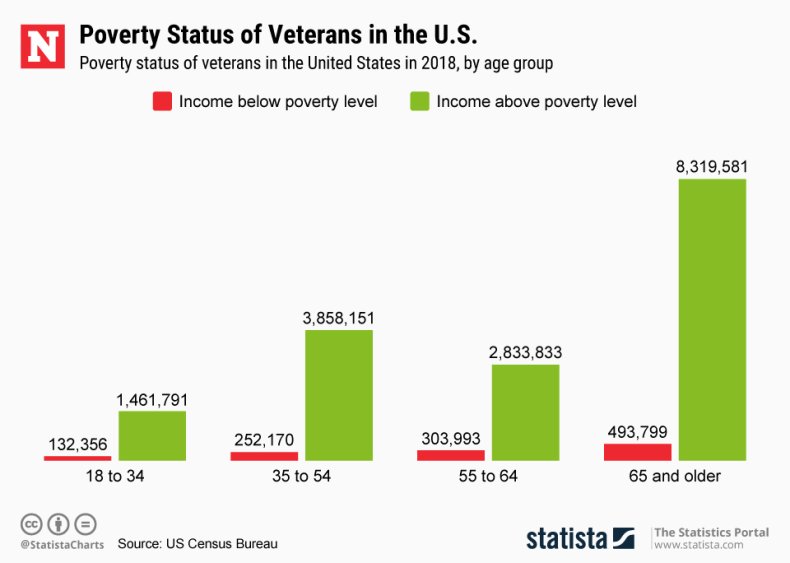
The graphic below, provided by Statista, shows that in 2018 the number of veterans aged 65 or higher up living with an income below the poverty level was 494,000. For the 55 to 64 historic period group, 304,000 veterans live with an income beneath poverty level. For 35 to 54, it is 252,000 living with an income below poverty level.

Do You Tell A Fireman Thank You For Your Service,
Source: https://www.newsweek.com/veterans-thank-you-service-veterans-day-support-1470776
Posted by: rosetaidew.blogspot.com
0 Response to "Do You Tell A Fireman Thank You For Your Service"
Post a Comment