

How Did The Selective Service System Contribute To The War Effort
 | |
| Other curt titles |
|
|---|---|
| Long championship | An Act to authorize the President to increment temporarily the military establishment of the United States. |
| Nicknames | Selective Draft Human activity of 1917 |
| Enacted by | the 65th United States Congress |
| Effective | May 18, 1917 |
| Citations | |
| Public police | Pub.50. 65–12 |
| Statutes at Large | xl Stat. 76, Affiliate xv |
| Codification | |
| Titles amended | 50 U.S.C.: State of war and National Defense |
| U.s.C. sections created | 50 UsC. Appendix §§ 201–211, 213, 214 |
| Legislative history | |
| |
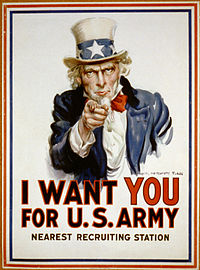
Uncle Sam pointing his finger at the viewer in order to recruit soldiers for the American Regular army during World War I, 1917-1918.

Sheet music cover for patriotic song, 1917
The Selective Service Act of 1917 or Selective Draft Act (Pub.L. 65–12, xl Stat. 76, enacted May 18, 1917) authorized the United States federal government to raise a national army for service in World War I through conscription. Information technology was envisioned in Dec 1916 and brought to President Woodrow Wilson'due south attention shortly after the break in relations with Deutschland in February 1917. The Human activity itself was drafted by then-Captain (later Brigadier General) Hugh South. Johnson later the United States entered Earth War I past declaring war on Deutschland. The Act was canceled with the finish of the war on November xi, 1918. The Human activity was upheld as constitutional by the United States Supreme Court in 1918.[1]
History [edit]
Origins [edit]
At the fourth dimension of Earth War I, the U.s.a. Regular army was small compared with the mobilized armies of the European powers. As late as 1914, the Regular Ground forces had under 100,000 men, while the National Guard (the organized militias of united states of america) numbered around 115,000. The National Defense Act of 1916 authorized the growth of the Army to 165,000 and the National Guard to 450,000 by 1921, but by 1917 the Army had only expanded to around 121,000, with the National Guard numbering 181,000.[two]
By 1916, it had become clear that whatever participation by the United states of america in the conflict in Europe would require a far larger army. While President Wilson at first wished to use only volunteer troops, it shortly became clear that this would be incommunicable. When war was declared, Wilson asked for the Regular army to increase to a strength of one million. But by half-dozen weeks after war was alleged, just 73,000 men had volunteered for service.[iii] Wilson accepted the recommendation of Secretary of War Newton D. Baker for a draft.
General Enoch H. Crowder, the Judge Advocate General of the United States Ground forces, when first consulted, was opposed. Merely later, with the assistance of Captain Hugh Johnson and others, Crowder guided the pecker through Congress and administered the typhoon equally the Provost Marshal General.
A trouble that came up in the writing of the bill and its negotiation through Congress was the desire of onetime President Theodore Roosevelt to assemble a volunteer forcefulness to become to Europe. President Wilson and others, including army officers, were reluctant to permit this for a variety of reasons. The terminal bill independent a compromise provision permitting the president to raise four volunteer divisions, a ability Wilson did non exercise.[4]
To persuade an uninterested populace to support the war and the draft, George Creel, a veteran of the newspaper industry, became the United States' official war propagandist. He set up the Commission on Public Information, which recruited 75,000 speakers, who made 750,000 four-minute speeches in 5,000 cities and towns across America. Creel subsequently helped form the American Alliance for Labor and Democracy, with union leader Samuel Gompers as president, to win working-grade support for the state of war and "unify sentiment in the nation". The AALD had branches in 164 cities, and many labor leaders went forth although "rank-and-file working class support for the war remained lukewarm ...", and the entrada was ultimately unsuccessful.[v] Many prominent Socialist leaders became pro-war, though the bulk did non.[half dozen]
Effects [edit]
By the guidelines set downward past the Selective Service Act, all males anile 21 to 30 were required to register to potentially be selected for military service. At the asking of the War Department, Congress amended the police force in August 1918 to expand the age range to include all men 18 to 45, and to bar farther volunteering.[7] By the cease of Earth State of war I, some two meg men volunteered for various branches of the armed services, and some 2.viii million had been drafted.[viii] This meant that more half of the nigh 4.8 million Americans who served in the armed forces were drafted. Due to the try to incite a patriotic attitude, the Earth State of war I draft had a high success charge per unit, with fewer than 350,000 men "dodging" the typhoon.
Differences from previous drafts [edit]

Young men at the first national registration twenty-four hour period held in association with the Selective Service Human activity of 1917.
The biggest difference betwixt the typhoon established past the Selective Service Human action of 1917 and the Civil War draft was that substitutes were not immune. During the Civil War, a drafted human being could avoid service by hiring some other human being to serve in his identify. A perception (generally inaccurate) spread that this option was primarily used by wealthy men, and was resented by those who couldn't afford information technology or considered it dishonorable.
This practice was prohibited in Department Three of the Selective Service Human activity of 1917:
No person liable to military service shall time to come be permitted or allowed to furnish a substitute for such service; nor shall any substitute be received, enlisted, or enrolled in the military service of the U.s.a.; and no such person shall be permitted to escape such service or to exist discharged therefrom prior to the expiration of his term of service by the payment of coin or whatever other valuable affair whatsoever as consideration his release from military service or liability there to.
National registration days and termination [edit]
During World State of war I at that place were iii registrations.[9]
- The outset, on June 5, 1917, was for all men betwixt the ages of 21 and xxx.
- The second, on June 5, 1918, registered those who attained age 21 after June 5, 1917. A supplemental registration, included in the second registration, was held on August 24, 1918, for those becoming 21 years onetime afterward June five, 1918.
- The third registration was held on September 12, 1918, for men age 18 through 45.
The Selective Service Act was upheld by the Usa Supreme Court in the Selective Draft Law Cases, 245 U.Due south. 366 (1918). The Solicitor General'due south argument, and the court'due south opinion, were based primarily on Kneedler five. Lane, 45 Pa. 238, 252 (1863), and Vattel's 1758 treatise The Law of Nations.[1]
Subsequently the signing of the ceasefire of November 11, 1918, the activities of the Selective Service System were quickly curtailed. On March 31, 1919, all local, district, and medical advisory boards were closed, and on May 21, 1919, the last land headquarters closed operations. The Provost Marshal Full general was relieved from duty on July 15, 1919, thereby finally terminating the activities of the Selective Service System of World State of war I.
Typhoon categories [edit]
Conscription was by class. The commencement candidates were to be drawn from Class I. Members of each class below Class I were available merely if the pool of all available and potential candidates in the grade above information technology were exhausted.
| Course | Categories (May 1917 – July 1919) | |
|---|---|---|
| I. | Eligible and liable for military service. | Single registrants with no dependents, Married registrants with independent spouse or one or more dependent children over 16 with sufficient family income if drafted. |
| Two. | Temporarily deferred, only available for military service. | Married registrants with dependent spouse or dependent children under sixteen with sufficient family income if drafted. |
| III. | Temporarily exempted, but available for military service. | Local officials. Registrants who provide sole family income for dependent parents or dependent siblings nether xvi. Registrants employed in agricultural labor or industrial enterprises essential to the state of war endeavour. |
| 4. | Exempted due to farthermost hardship. | Married registrants with dependent spouse or dependent children with insufficient family unit income if drafted. Registrants with deceased spouse who provide sole family income for dependent children under 16. Registrants with deceased parents who provide sole family income for dependent siblings nether sixteen. |
| Five. | Exempted or ineligible for induction into military service. | State or Federal officials. Officers and enlisted men in the military or naval service of the Us,[10] Licensed pilots employed in the pursuit of their vocation.[x] Members of the clergy. Students who on or before May 18, 1917 had been preparing for the ministry in a recognized theological or divinity school.[x] Registrants who were accounted either medically disabled (permanently physically or mentally unfit) or "morally unfit" for war machine service. Registrants shown to accept been convicted of whatsoever criminal offence designated as treason or felony, or an "infamous" criminal offense.[10] Enemy aliens and resident aliens.[10] |
African-Americans [edit]
The American war machine was entirely segregated at the fourth dimension of Earth War I. While the Army had several regiments of black "Buffalo Soldiers", many politicians such as Sen. James K. Vardaman (Mississippi) and Sen. Benjamin Tillman (S Carolina) staunchly opposed any expanded armed services part for black Americans. Yet, the State of war Department decided to include blackness people in the draft.[11] A total of 2,290,527 black Americans were ultimately registered for the draft during the 2 calls of June ii and September 12, 1917 – nine.six percent of the full American pool for potential conscription.[xi]
Typhoon board officials were told to tear off the lower left-mitt corner of the Selective Service grade of a black registrant, indicating his designation for segregated units.[xi] The August 1917 Houston Riot, when armed black soldiers fired upon Houston law and civilians, as well afflicted the War Department's decision-making. The great majority of blackness soldiers were employed just in labor functions, such equally road-edifice and freight-handling.[12] Simply ii black gainsay units of were ultimately established – the 92nd and 93rd Infantry Divisions.[xiii] Blackness Americans were entirely excluded from the United states of america Marine Corps and were consigned to menial labor in the United States Navy for the duration of the state of war.[fourteen]
See as well [edit]
- Conscription in the Us
- Selective Service System
Footnotes [edit]
- ^ a b Leach, Jack Franklin (1952). Conscription in the United States: Historical Groundwork. Rutland, Vermont: C.E. Tuttle Pub. Co. p. 6. OCLC 1727243.
- ^ Grotelueschen, Mark E. (2007). The AEF Way of War: The American Regular army and Combat in World War I . Cambridge University Press. p. 11.
- ^ Zinn, Howard (2003). People'southward History of the United States. Harper Collins. p. 364.
- ^ Coffman, Edward K. (1998). The War to End All Wars: The American Armed forces Feel in Earth War I . University Press of Kentucky. pp. 25–28.
- ^ Weinstein, James (1969). The Corporate Ideal in the United States 1900–1918. Boston: Beacon Press.
- ^ Zinn, pp. 364–365.
- ^ Coffman, p. 29.
- ^ "Selective Service System: History & Records". Retrieved December 27, 2005.
- ^ "World War I Draft Registration Cards", US National Archives
- ^ a b c d east Swarthmore College Peace Collection, Military Classifications For Draftees, World War I (1917)
- ^ a b c Williams, Chad L. (2010). Torchbearers of Democracy: African American Soldiers in the Globe War I Era. Chapel Hill, North Carolina: University of North Carolina Press. p. 53.
- ^ Williams, Torchbearers of Democracy, p. 54.
- ^ Williams, Torchbearers of Republic, p. 2.
- ^ Williams, Torchbearers of Democracy, p. 6.
External links [edit]
- Geheran, Michael: Selective Service Act , in: 1914-1918-online. International Encyclopedia of the First World State of war.
- Strauss, Lon: Social Disharmonize and Control, Protest and Repression (USA) , in: 1914-1918-online. International Encyclopedia of the Start World State of war.
- Forest, Margaret. "World War I: Conscription Laws." Library of Congress Blog. September thirteen, 2016. Concluding accessed May ix, 2017.
- "World War I." Library of Congress Online. Last accessed May nine, 2017.
- "An Act To authorize the President to increase temporarily the Military Establishment of the Usa." Statutes at Large. May xviii, 1917, H.R. 3545. Last accessed May ix, 2017.
- An Human activity Amending the Act entitled "An Act to authorize the President to increase temporarily the War machine Establishment of the U.s.," approved May eighteenth, nineteen hundred and seventeen. Statutes at Large. Web. Baronial 31, 1918, H.R. 12731. Last accessed May nine. 2017.

How Did The Selective Service System Contribute To The War Effort,
Source: https://en.wikipedia.org/wiki/Selective_Service_Act_of_1917
Posted by: rosetaidew.blogspot.com
0 Response to "How Did The Selective Service System Contribute To The War Effort"
Post a Comment